 English
 Español
 عربى
عربى
AC Electric Motor Controller: Types, Technologies & Selection Guide
Around 25% of all electricity consumed globally passes through an electric motor. The vast majority of those motors run on AC—induction motors, permanent magnet synchronous motors (PMSMs), and synchronous reluctance motors powering pumps, fans, compressors, conveyors, and electric vehicles across every sector of industry. What sits between the power supply and the motor—the AC electric motor controller—determines how efficiently all that energy gets used, how precisely the motor responds to commands, and how long the mechanical system lasts.
The technology inside AC motor controllers has changed dramatically over the past two decades. What was once a contactor and a fixed-speed starter is now a sophisticated power electronics system capable of adjusting voltage, frequency, and current waveform in real time. Understanding the controller types, their operating principles, and their selection criteria is the foundation for building any reliable AC drive system.
Content
- 1 The Variable Frequency Drive: The Universal Standard for AC Motor Control
- 2 Scalar (V/f) Control: The Simple, Cost-Effective Starting Point
- 3 Vector Control and FOC: High-Performance AC Motor Control
- 4 Soft Starters: Reducing Inrush Without Variable Speed
- 5 PMSM Controllers: Bridging AC and Brushless DC Technology
- 6 Key Applications Across Industries
- 7 How to Select the Right AC Electric Motor Controller
The Variable Frequency Drive: The Universal Standard for AC Motor Control
A Variable Frequency Drive (VFD)—also called an inverter drive, AC drive, or variable speed drive—is the dominant controller technology for AC motors in both industrial and commercial applications. Its operating principle is straightforward in concept: convert the incoming AC supply to DC, then reconstruct a variable-frequency AC output using pulse-width modulation (PWM) to drive the motor at any desired speed.
The three-stage architecture—rectifier, DC bus, inverter—gives the VFD complete authority over both the voltage and frequency delivered to the motor. Since the synchronous speed of an AC induction motor is directly proportional to supply frequency, varying the output frequency from a few Hz up to well above 50/60 Hz gives full speed control from near-zero up to high-speed operation. Modern VFDs achieve this with efficiencies typically above 96–98%, making them highly effective even accounting for the conversion losses.
The energy savings potential is substantial for variable-torque loads like fans and pumps. A 20% reduction in motor speed cuts power consumption by approximately 50%, and a 40% reduction cuts it by nearly 80%—a direct consequence of the cube-law relationship between speed and power in centrifugal machines. This is why VFDs have become standard equipment in HVAC, water treatment, and industrial process systems where load varies over time. Learn how our T-series high-performance motor controllers apply advanced inverter technology for demanding AC drive applications.
Scalar (V/f) Control: The Simple, Cost-Effective Starting Point
Within the VFD category, the simplest control strategy is scalar control—also called V/f (volts-per-hertz) control. The controller maintains a fixed ratio between output voltage and output frequency across the entire speed range. As frequency increases, voltage increases proportionally, keeping the magnetic flux in the motor roughly constant and preventing the motor from saturating or losing torque capacity.
V/f control requires no feedback from the motor and no knowledge of motor parameters beyond the rated voltage and frequency. Setup is simple—often just three parameters—and the drive works with virtually any standard AC induction motor without tuning. This makes scalar control the right choice for simple fan and pump drives, conveyor systems, and any application where speed regulation accuracy of ±2–5% is acceptable.
The limitation is dynamic performance. Because V/f control does not separately regulate torque and flux, the motor's response to sudden load changes is slow, and torque at low speeds is reduced. For applications requiring precise speed hold under variable load, or for motors that must respond quickly to dynamic commands, vector control is necessary.
Vector Control and FOC: High-Performance AC Motor Control
Vector control—specifically Field-Oriented Control (FOC)—transforms AC motor control from a frequency-domain problem into a torque-domain one. By mathematically decomposing the motor's stator current into two independent components—one that controls flux, one that controls torque—the controller can regulate each independently and in real time.
The practical result is that an AC motor under FOC behaves much like a DC motor in terms of dynamic response: torque commands are executed immediately, speed is held accurately under load transients, and the motor can be operated with full torque at very low speeds or even at standstill. FOC-based AC drives are standard in CNC machining centers, robotics, electric vehicle traction systems, and any application where tight speed regulation and fast torque response are required.
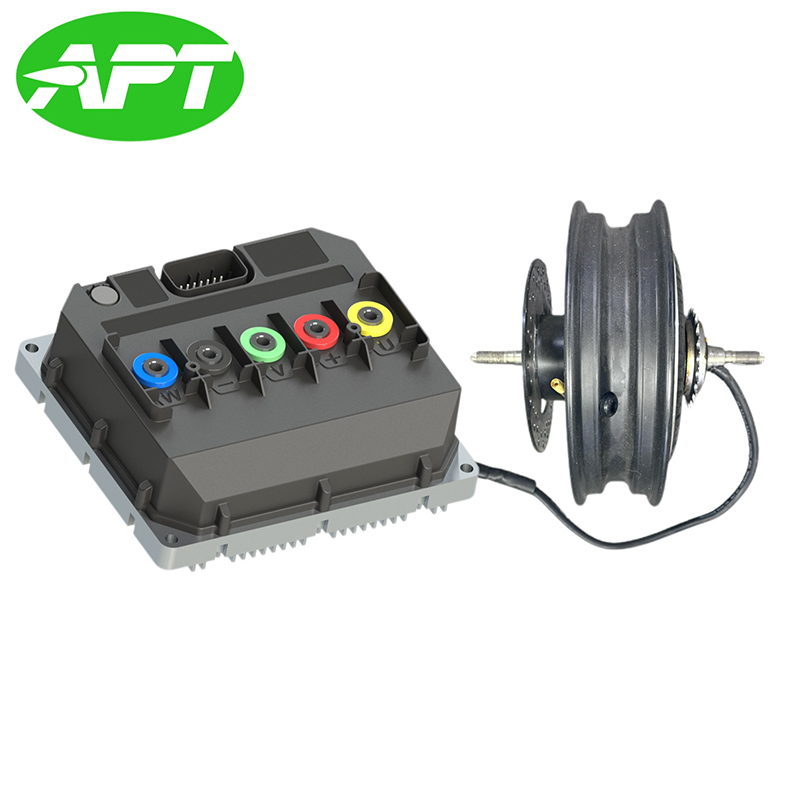
There are two variants. Sensorless vector control estimates rotor speed and position from measured stator voltages and currents—no encoder required. Closed-loop vector control uses an encoder or resolver mounted on the motor shaft for direct position feedback, enabling the highest accuracy. The choice between them depends on the required minimum operating speed and positioning accuracy. For applications combining hub motor or mid-drive motor with precise electronic control, our controller and motor pairing guide details the correct matching between controller algorithm type and motor design.
Soft Starters: Reducing Inrush Without Variable Speed
Not every AC motor application needs variable speed. Many pumps, compressors, and conveyor drives run at a single fixed operating speed but suffer from mechanical and electrical stress at startup: a direct-on-line (DOL) start draws 5–8 times rated current for several seconds and applies full torque instantaneously to the mechanical drivetrain.
A soft starter addresses this specific problem without the full complexity of a VFD. By using back-to-back SCRs (thyristors) to progressively increase the voltage applied to the motor during startup, a soft starter ramps the motor up over a controlled time period—typically 3–30 seconds. Current inrush is reduced to 2–4 times rated current, mechanical shock is eliminated, and the power supply infrastructure (cables, switchgear, transformers) experiences far less stress.
Once the motor reaches full speed, the soft starter either bypasses itself (closing a contactor to connect the motor directly to the supply) or remains in circuit at full conduction. It plays no role in speed control during running—the motor runs at its rated synchronous speed determined by supply frequency. Soft starters are the most cost-effective solution for fixed-speed loads with high inertia or frequent starts, such as compressors, large fans, and conveyor systems with heavy belt loads.
PMSM Controllers: Bridging AC and Brushless DC Technology
Permanent Magnet Synchronous Motors (PMSMs) are increasingly common in both industrial drives and electric mobility applications. They offer higher efficiency than standard induction motors—particularly at partial load—and their power density makes them attractive where weight and size matter. However, they require a controller that can handle the specific characteristics of a synchronous machine: no rotor slip, precise phase angle control, and sensitivity to field-weakening conditions at high speed.
PMSM controllers are essentially FOC-based AC drives adapted for synchronous motor dynamics. In the electric mobility sector—e-bikes, scooters, light EVs—the PMSM controller is often implemented as a compact, sensorless or Hall-sensored brushless DC controller operating on battery DC input. In industrial applications, three-phase PMSM drives run directly from AC supply via a VFD front end, with FOC algorithms optimized for synchronous machine equations rather than induction motor models.
The rapid improvement of permanent magnet motor technology and control algorithms is accelerating adoption across industrial sectors. For an in-depth look at how PMSM technology continues to evolve and reshape industrial drive systems, see our dedicated industry analysis.
Key Applications Across Industries
AC electric motor controllers appear in virtually every industrial and commercial sector. The performance demands of each sector shape which controller type and control algorithm is most appropriate:
- HVAC and building systems: Fans, pumps, and chiller compressors running on VFDs with V/f or sensorless vector control. Energy savings from variable speed operation are the primary driver. VFDs in fan and pump applications typically deliver energy savings of 40% compared to fixed-speed operation with throttling valves.
- Water and wastewater treatment: Submersible pump drives, aeration blowers, and centrifuge drives require VFDs capable of reliable operation in harsh environments with high starting torque and protection against pump dry-running and pipe resonance.
- Manufacturing and material handling: Conveyor systems, packaging machines, and handling robots use vector-controlled drives for precise speed coordination across multiple axes. Coordinated multi-drive systems require tight speed regulation and fast torque response.
- Electric mobility and light EVs: Hub motors and mid-drive motors in e-bikes and light electric vehicles are driven by compact AC/BLDC controllers with FOC algorithms, operating from battery DC input. Our hub motor range and mid-drive motor series are designed for pairing with high-efficiency FOC motor controllers.
- Process industries: Extruders, mixers, centrifuges, and winding machines in chemical, food, and pharmaceutical plants use closed-loop vector drives for precise tension and speed control under varying process loads.
How to Select the Right AC Electric Motor Controller
Getting the selection right requires working through several interdependent parameters. Skipping any one of them risks either underperformance or premature failure.
- Motor type and rated parameters: Confirm whether the motor is a squirrel-cage induction motor, wound-rotor induction motor, PMSM, or synchronous reluctance motor. Each type requires specific controller algorithms and parameter sets. Match the controller's rated output voltage and current to the motor's nameplate values with appropriate derating for ambient temperature and altitude.
- Speed range and regulation requirement: V/f control suffices for constant-torque loads requiring ±5% speed regulation. Sensorless vector control achieves ±0.5% without encoder. Closed-loop vector control with encoder achieves ±0.01% and enables full-torque operation at zero speed.
- Torque profile: Variable-torque loads (fans, pumps) allow a smaller controller relative to motor power. Constant-torque loads (conveyors, extruders) and high-inertia loads require the controller to be sized for the actual worst-case torque, including startup and dynamic braking.
- Supply and environmental conditions: Confirm input voltage, frequency, and phase count. Verify the enclosure rating matches the installation environment—IP20 for clean panel mounting, IP55 or higher for dusty or washdown locations. Check operating temperature range and confirm adequate derating if ambient exceeds 40°C.
- Communication and integration: Modern AC motor controllers support fieldbus protocols—Modbus RTU, CANopen, EtherCAT, Profibus—for integration into PLC-based automation systems. Confirm the required interface before selecting a controller model.
For applications where both controller and motor are selected together, a matched drive-motor system delivers better performance than independently sourced components. Our consumer and commercial motor controller range and our guide to software-defined motor control provide the technical foundation for making an informed, application-specific selection.
NEXT:Sensorless Brushless Motor Controller: How It Works & When to Use It
Interested in cooperation or have questions?
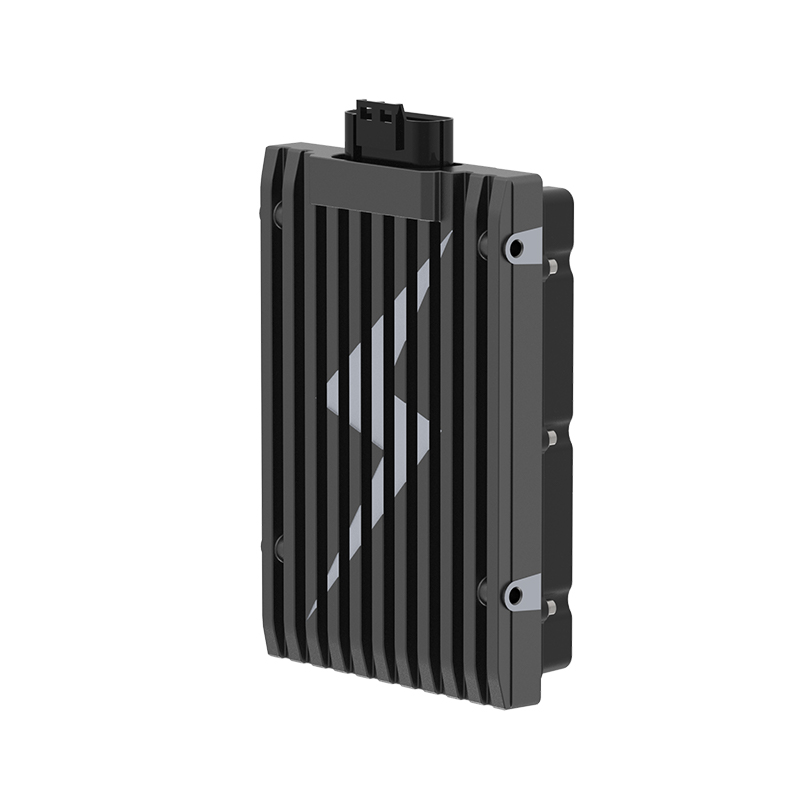
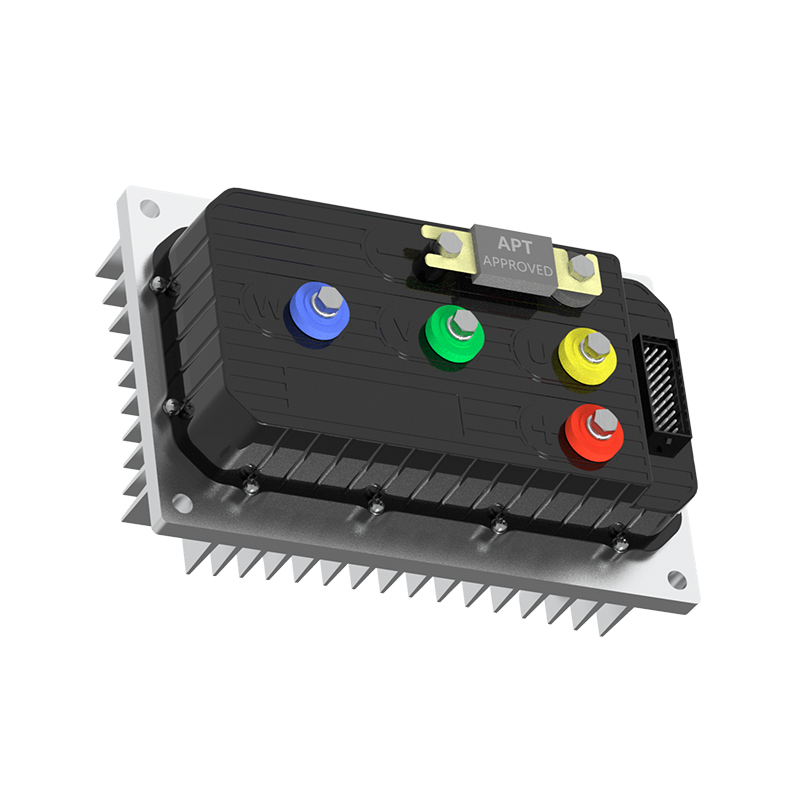

As Custom Permanent Magnet Synchronous Motor Controllers Manufacturers and Permanent Magnet Motor Controllers Suppliers in China, Focusing on the drive control of permanent magnet synchronous motors, we provide a safe and sufficient power source for the electrification of travel vehicles.
- [email protected]
- +86-170 9191 9800
- Room 123A, No. 1000 Ziyue Road, Minhang District, Shanghai, China
Copyright © Shanghai APT Power Technology Co., Ltd.All rights reserved

